Before we start: This entire blog on the Gayatri Mantra is based on the interpretation by the learned Dr. Sri Bannanje Govindacharya’s Kannada pravachana (lectures) on the same topic. I have used the literary freedom where appropriate to add context and contemporize the explanations.
Very little of what is written in these posts is born out of my personal experience – this is an attempt to simplify and “open source” the interpretation of a few foundational elements of our scriptures and dharma.
In my previous post, there was an introduction to the Vishwamitra Gayatri mantra.
ॐ (Om): Synthesis from Vedic Alphabets
In Devanagari script, the first verse of the Gayatri Mantra is as follows:
ॐ भूर्भुवःस्वः In English: Om Bhuur-Bhuvah Svah
The first sound we encounter is ॐ (Om).
First, we need to break down the ॐ (Om) sound into three syllables :
- अ (aa, resembles pronunciation of vowel u in the word cut)
- उ (u, resembles pronunciation of vowel u in the word put)
- म (mm, pronounced as mm, and not as ‘ma’)
If we understand the origin and intent of fusing these three syllables or sounds together to form the sound of ॐ, we will get closer to understanding ॐ itself.
Appreciating this alphabetic synthesis needs us to look towards the Vedas. Our heritage is embodied in the scriptures, and the pillars of this heritage are the Vedas. It is universally acknowledged that there are 4 Vedas — Rig Veda, Yajur Veda, Saama Veda, and Atharva Veda. Our quest here is to go beyond Wikipedia and unravel the synthesis of ॐ, and the first step is to understand how these 4 Vedas are structured.
Rig Veda is a set hymns, that is primarily based on poems written to certain meters – or chandas. Yajur Veda is primarily prose based. These two Vedas provide all the basic material for the Vedic literature. Saama Veda, on the other hand, is about adding music and melody to basic text as obtained from Rig Veda and Yajur Veda. To reiterate, Saama Veda does not really add any new text to the Vedic literature – it adds melody (most text comes from Rig Veda).
Why are we talking about Vedas, didn’t we start looking at the Gayatri Mantra and ॐ (Om), you might be wondering. The Gayatri Mantra is considered the essence of all Vedas; if the Vedas constitute a full library, think of the Gayatri Mantra as the library card that unlocks literary treasures and gives you unlimited access. It is up to you, the reader, to navigate your way through this veritable library where multiple guides, indexing systems and maps like the Gayatri Mantra and the Bhagavadgita make your quest easier.
Let us turn back to our alphabetic synthesis.
The most ancient of all Vedas, the Rig Veda, starts off like this:
अग्निमीळे पुरोहितं यज्ञस्य देवं रत्वीजम | होतारं रत्नधातमम ||
aghnimīḷe purohitaṃ yajñasya devaṃ ṛtvījam | hotāraṃ ratnadhātamam ||
It is sufficient at this time to know that the first hymn is in praise of Agni – the Fire God. For Hindus, Fire represents purity, a symbol that is both formless and with form at the same time, and full of energy. It is important to note the first alphabet in the Rig Veda — अ (aa, resembles pronunciation of vowel u in the word cut) — which is also the first alphabet in ॐ (Om).
Rig Veda ends with the hymn :
समानी व आकूतिः समाना हर्दयानि वः | समानमस्तु वोमनो यथा वः सुसहासति ||
samānī va ākūtiḥ samānā hṛdayāni vaḥ | samānamastu vomano yathā vaḥ susahāsati ||
Again, this hymn is in reverence to Agni, and ends with the syllable इ (e, the beginning sound of i in India).
To sum up what we have seen till now, the Rig Veda starts with the letter अ (aa), and ends with इ (e).
Moving on, to the second sound in ॐ (Om), the sound of उ (u). To save the suspense, it is sufficient to note that the Yajur Veda starts with the sound of इ (e) and ends with the sound of उ (u).
So, the first two sounds of ॐ (Om) act as bookends of the two major Vedas — Rig and Yajur — and ring fence the majority of Vedic knowledge.
The third sound is म (mm, pronounced as in hmm, and not as ma). While the first two alphabets embody the text of the Vedas and their message, the last alphabet represents the Saama Veda, and adds melody and an unmistakable calming vibration to the basic sound of ॐ (Om).
The picture below summarizes the synthesis of ॐ from the Vedic alphabets.
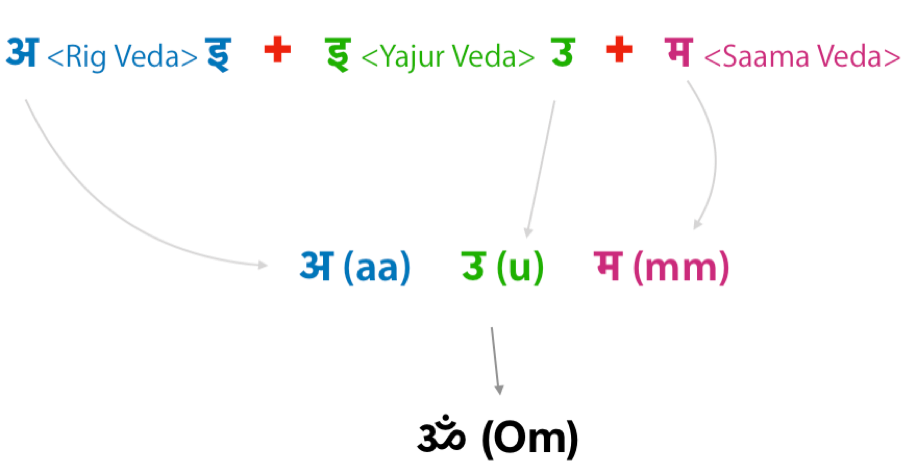
ॐ (Om): An Etymological View
Let us move to the next stage of understanding ॐ (Om). In the previous section, we settled on three alphabets bookending the Vedas and representing all of Vedic knowledge in a single powerful chant. Simply put: ॐ = अ + उ + म.
The term “etymology” means the study of origin of words, and the evolution of their meanings over time. This discipline is very relevant for Sanskrit which retains the richest etymological underpinning in Vedic literature.
अ : The negation
Simply put, अ negates the meaning of its suffix or succeeding word.

 The Gayatri Mantra